Sunday, 16 February 2014

Review: How Angels Die by David-Michael Harding

It is 1944 and France is resisting the Nazi invasion as best as it can, hoping that the rumours of an Allied invasion come to fruition.  Two sisters, Monique & Claire McCleash are part of the Resistance but they operate in totally different spheres.  Claire goes on operations, ambushing and killing German soldiers whereas Monique goes to a well known club and seduces German officers in order to garner intelligence that could prove useful to their movement.

Monique's role is a constant source of hurt and betrayal to Claire and the sisters are battling each other as much as the Nazis.  When their Resistance cell is in danger of being discovered, a series of tragic events reveal family secrets that will have the power to rip the McCleash family apart or make it stronger than ever.


REVIEW:

This is an extremely well-written and disturbing independent novel.  It is rare that an author will examine the role of women in wartime, especially ones who take such a dangerous and proactive role in resisting their oppressors.

The plot is simple, but fraught with suspense, intrigue and danger.  You immediately strike up an affinity with both of the McCleash sisters and David-Michael Harding has a talent for creating flawed characters who find themselves at war, not only with an enemy force, but with people they love.

This book is not easy reading, it will challenge your perceptions and morals but saying that it has been produced to a high standard and the quality of the prose, the construction of the plot and the creation of the characters are perfectly executed.  This is a very good novel and I look forward to reading more of Mr Harding's work.

I give "How Angel's Die" 4 Crosses!!

X X  X X

Sunday, 9 February 2014

Review: Sebastian's Way - The Pathfinder (Book 1) by George Steger

In 8th Century Europe, the Frankish-Saxon War rages and the legendary warlord Charlemagne is ruling over conquered lands.  His brutal method of war is effective and he begins to feel the long campaign is nearing its end and looks to build a prosperous and stable society where peace and prosperity are in abundance.

A local, seemingly unassuming boy named Sebastian has taught himself to read alongside honing his battlefield skills and his years to diligence stand him in good stead because Charlemagne notices him and he becomes a close confidante of the King.  And then the politics and intrigue of Court begin to hinder Sebastian's rise as the jealousy and ambition of his peers begin to surface.  His rivals are quick to judge his open opposition to the brutal methods used by Charlemagne as Sebastian tries to show him a different method, one that wins hearts and minds rather than shatter spirit and obliterate opposition.

Sebastian's cousin, Konrad, does his utmost to destroy Sebastian and he finds himself increasingly isolated.  Can a man hold his principles and morals whilst those around him disregard their own in order to discredit him?


Review:
This is a boys own adventure that will keep you interested from beginning to end.  I know little about the life and times of Charlemagne but found myself looking him up and finding out more about this most fascinating character.  I cannot comment on the historical accuracy of the novel but it has been written by a Professor of History who knows the period and is very familiar with Charlemagne, so one would assume the accuracy is pretty much spot on.

There is a lot of brutal violence in this book, so if you prefer your history a little watered down, this story may not be for you.  But saying that, the character of Sebastian as a moral conscience is a good foil to the bloodthirsty Charlemagne.  Some would argue the character is a little too 21st Century in his outlook, but overall it works extremely well.


This independent novel is  a solid debut for Colonel George Steger and I look forward to the next volume in the series.  I give Sebastian's Way: The Pathfinder 4 Crosses.

X X  X X

Friday, 31 January 2014

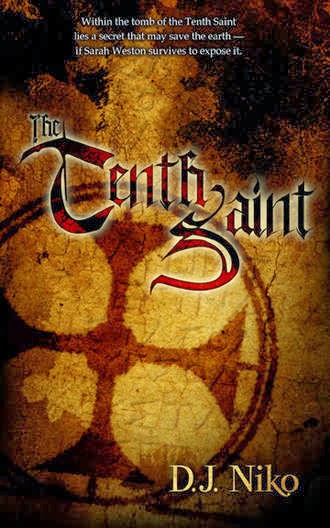
Review: The Tenth Saint by D.J. Niko

Dr Sarah Weston is an archaeologist working at a site in Ethiopia when she bumps into a stranger who tells her of a cave in the hills above her camp.  The man shows her shards of pottery that seem unusual and so, her interest outweighing her personal safety, she agrees to meet the man the following day and trek to the cave.  When she gets there, she finds strange markings and inscriptions that imply this is an undiscovered marvel.

She reports her findings to her mentor back in England and he is less than impressed with Sarah's lack of commitment to her current project.  He informs her that an American anthroplogist, Daniel Madigan, is joining her "dig" and will be keeping an eye on her as there are concerns she is not the person her sponsors want for their project.  Sarah shows Madigan her findings and it becomes apparent this could be the tomb of a lost Coptic Saint and the writings are a portent describing how and when the world will end.  What follows is a fast-paced, girls own adventure steeped in history and myth as Sarah and Madigan try to solve the mystery and stop the prophecy from coming true.


REVIEW

Okay, this is not strictly a historical fiction novel and for the purist readers of the genre who kindly follow my blog, I apologise for that.  But this is a very good story that will satisfy the historical element, excite those who like adventure, enthral those who love conspiracies (me!) and have you devour every twist and turn of the plot.

D.J. Niko has followed a well trodden path by writing in this genre, but the sign of a great writer is how they make the story unique, or give it an edge.  The use of a female protagonist who is beautiful but tough, single-minded but unbiased, is unusual but works extremely well.  Niko has found the perfect balance in her character to turn the stereotypical female heroine on its head, if I have a criticism it is that more should have been done to Daniel Madigan to make him unique as he is a bit too "Indiana Jones" and this I feel detracts slightly from Sarah Weston.

Overall though, this is a good read.  It is full of suspense, the historical theme has been well researched and the plot flamboyant.  This is a perfect book to read if you want a bit of comfort on a cold, wet day when you want some excitement.

I give "The Tenth Saint" 4 Crosses!

X X  X X

Friday, 17 January 2014

Review: The Tudor Conspiracy by Christopher Gortner

It is 1553 and Mary Tudor is still firmly at odds with her half-sister, Princess Elizabeth.  There are rumours abound that Elizabeth, after being invited to Court, is now a prisoner.

Brendan Prescott is contacted by Elizabeth's spymaster Sir William Cecil and asked to resume his undercover personae of Daniel Beecham, to infiltrate the murky corridors of power and determine the exact nature of peril aimed at Elizabeth and to rescue her from a fate worse than death.  There is danger around every corner and the discovery of a cache of the Princess's private letters pulls Brendan, and the heir to the throne, into mortal danger once again.  In a palace where no one can be trusted and everyone seems to be a double agent, Prescott must once again use all his wits and intelligence to keep England's future monarch safe.


Review

Once again Christopher Gortner has delivered what I would most definitely describe as an almost perfect historical novel.  Fictitious, yet utterly convincing, characters are interwoven seamlessly with real life people and the inventiveness of his plot is truly enthralling.

For those of you who enjoy fast paced, cleverly constructed novels of any genre, this one should be on your "to be read pile" and put as close to the top as possible.  Gortner is a master story-teller, his passion for history is obvious in his work and his research is flawless.  You realise you are being given an education in the Tudor period and the way people lived their lives in a time when being born into the "wrong" religion could be a death sentence.  He brings the past to life in a way only a few writers can.

The principal character, Brendan Prescott, is one you side with right from the very off & you root for him and his success.  There are times I did feel the danger was a bit too much, turning him into a Tudor James Bond, but it is a small criticism because this is a magnificent story.

I give "The Tudor Conspiracy" 5 Crosses!!

I am also awarding Christopher the prestigious "Golden Hammer and Anvil Shield Award" for this superbly entertaining and well written book.  

X X X  X X


Monday, 13 January 2014

Review: The Assassin's Mark by David Ebsworth

In 1938, Europe is on the brink of a second Great War in less than thirty years and the dark spectre of National Socialism is looming over several European countries.  The Spanish Civil War has been going on for two years and, in an arrogant show of confidence, General Franco has begun to operate "Battlefield Tours" - package holidays of the recent and famous war zones for tourists.

Jack Telford, a journalist with a left wing newspaper, is sent to report on the tours and tries to uncover the underlying reasons for the war.  However his eccentric holiday making companions along with a power hungry tour guide make his task difficult.  Then one of the tourists is murdered and Telford is captured by Republican guerillas, putting his life in danger as he tries to solve the murder and save his own sanity.

Review

I know little of the Spanish Civil War and so I began reading this novel with a sense of anxiety, being out of one's comfort zone can be challenging can't it?  However, within a few pages I was hooked by David Ebsworth's wonderful story and eloquent, yet light, prose.  He quickly establishes characters and their personalities, providing you with the boundaries of "goodie & baddie" before flipping the whole premise on its head and bringing a whole new perspective to the story.

If you enjoy passionate characters, with a well-researched and deep historical plotline then you really need to read this book.  It has been crafted with exceptional care and whether you buy it on Kindle or in paperback, I can quite honestly say that this book is a keeper!

I give "The Assassin's Mark" 4 Crosses!

X X  X X

Ebsworth's Mark - interview with David Ebsworth

First of all, Stuart, it’s a real thrill for me to do the interview. Thanks very much for arranging this home stop on the Book Tour.

You’re welcome. And maybe you could start by telling us how you developed the story for Assassins? I’d never heard about the background before.

OK, so it’s 1938, and Spain is in the grip of the civil war that had started two years earlier after an attempted military coup by General Francisco Franco. The story of the Spanish Civil War has been covered from lots of angles but I came across the previously untold fact that, in the middle of ’38, with the outcome still in the balance, Franco had not only set up an alternative government but had established a Tourist Department – and then circulated brochures around all of Europe’s travel agents, inviting tourists to visit his recently won battlefields. Extraordinary! An incredible propaganda exercise. But it worked. Something like 20,000 travellers took part in the tours over the following seven years and, of course, carried away Franco’s side of the complex conflict. So I thought: What if one or more of the people on the tour bus didn’t believe the propaganda? What if one or more of them had hidden agendas? What if a batch of unforeseen disasters befell these eccentric travellers? I hope readers will think it’s an original way to find out about this still relevant piece of European history.

I did some digging of my own on this, and found that a lot of the characters who feature in this story are real people. Far more than I’d imagined. Did that create problems?
Actually, I don’t think anybody else has spotted that. The characters who make up the bus-load of travellers are all fictional – though even some of them are based on real people. But the rest are mostly factual. As Franco’s armies slowly occupied each area of Spain, they replaced all the democratically-elected representatives with their own stooges, either from the military, or from the extreme Right-wing and fascist Falange Party. It still exists, by the way. And these were the people largely responsible for rounding up tens of thousands of socialists, communists, trade union leaders, poets and artists, and murdering them in what historian Paul Preston has quite rightly called “the Spanish holocaust”. So the tours would have met a lot of these people and I wanted – within reason – to get inside them a little. And, actually, there’s an astonishing amount of information available. So no, it didn’t create a problem. Though I’m always conscious that it might become so. The book’s selling reasonably well in Spain, even in English, so naturally there’s always a chance that the family of one of those people may pick up Assassins and not be happy about the portrayal.

I also realised that both Assassins and your previous novel, The Jacobites’ Apprentice, feature lots of stuff about spies. Is this a subject that intrigues you?
D’you know, I hadn’t thought about that before. Jacobites is set in 1745, mainly based in Lancashire and deals with the Manchester merchants who supported Bonnie Prince Charlie in his rebellion. But, yes, its anti-hero is based on the real-life spy, Dudley Bradstreet, who was almost single-handedly responsible for preventing the rebellion’s success. The Jacobite army managed to travel all the way south to beyond Derby, with not much more than 100 miles before they reached London. And there was nobody to stop them. But Bradstreet, posing as a scout for Bonnie Prince Charlie, told him a load of nonsense about English armies waiting to intercept them. The Jacobites lost their bottle, went back to Scotland, and the rest is, of course, history. In Assassins, I became fascinated by the dozens of attempts on Franco’s life – sometimes by professional spies and hit-men, sometimes by rank amateurs. And there was a whole espionage story about the British covert operations that may have helped Franco launch his fascist coup in the first place. But there’s no spying in the third novel. Honest!

Ah, the third book? What’s that about?
It’s set during the second half of the Anglo-Zulu War in 1879. In a nutshell, it picks up the story where Michael Caine and the film, Zulu, left off. It’s told largely from a Zulu perspective and the title is The Kraals of Ulundi, due to be published in April-May.

And you write under a pen name. Can you tell us why?
When I started writing, I soon began to run into problems. There are some quite evil moments in Jacobites and I found it quite hard, personally, to delve inside those darker sides of human nature as myself. So I needed to develop an alter ego. And then I realised that this wasn’t hugely different from my earlier “day job.” I think most of us are different people in work than we are at home with our families. Then, of course, I began to realise exactly how many of my own favourite authors have written under pen names, and I imagine that some of them must have similar reasons for doing so - C.S. Forester, Daniel Defoe, Ellis Peters, George Orwell, J.K. Rowling, John Le Carré, Lewis Carroll, Patrick O’Brian, Stendhal and dozens of others. Apart from all that, when I finally started thinking about marketing, I realised that “Dave McCall” simply doesn’t sound like the name of a historical fiction writer. Well, not to me it doesn’t! So the “David Ebsworth” brand was born. Ebsworth is a grandfather’s name so it feels right. Then, when I shut my workroom door each morning, I get straight into this alter ego and start to write.

You have a writing routine, then? How do you fit that into your day job?
I officially retired in 2008 so haven’t really got a “day job” any more. I do some voluntary work still but, mainly, I write. I start around 7.00am by word processing the most recent hand-written stuff that I’d worked on during the previous day. That’s important for me since it gets me straight back into the story without risking writers’ block. By the time I’ve finished this word processing, I’m “in the groove” and carry on with new word count until maybe 9.30am. Then I print out the morning’s work and take myself off to the swimming pool, do my lengths and mull over what I’ve done. An hour later usually sees me in Caffè Nero, making corrections and then hand-writing the next block of text. That’s the text that I put away until the following morning. During the afternoon and evening, I catch up with my marketing and any research that I need for the next section of the book.

When you say “marketing”, can you say a bit more about that?
Sure. It had never occurred to me that there’d be so much marketing if you want your books to sell. That sounds daft, but I genuinely hadn’t thought about it. When I was writing Jacobites, I never thought about anything except getting to The End. I just assumed that “somebody” would do the marketing for me if it even got published. But that “somebody” doesn’t exist and, by the way, it’s really no different for authors who are “traditionally” published. Though I caught on quickly, I think. I developed a marketing calendar with all the things I needed to do before publication (developing and regularly updating a website, arranging launch events, building a social media profile on Goodreads, Twitter, Facebook, Google Plus, Pinterest, etc); at publication (press releases and interviews, arranging book reviews); and post-publication (getting myself invited to author events, month by month, sometimes in bookstores but, more productively, doing lively presentations about the story backgrounds). Then it’s a matter of juggling all these plates and many more besides. But my main bit of marketing is the production of a monthly e-newsletter that goes out to family, friends, supporters and readers – whose e-mail addresses I’ve been painstakingly accumulating over the past three years, since Jacobites was published. I’ve never really found time for regular blogging – and the newsletter is a great substitute.

That’s a good tip. Can you give any aspiring writers just one more?
Yes. To keep writing. I think we have to be hugely talented or extremely lucky to sell huge quantities of books at our first attempt. But if you build up some readership with your first book, do some basic marketing, then go on and write a second, then a third, and so on, that readership will grow incrementally and irrevocably. I’m certain that there must be a mathematical formula for this. I just don’t know what it is! The main thing is to keep writing books – doing it well, naturally – and getting them published, even if you can only manage eBook editions. Write them and they will come! In today’s market, I think it’s both quality and quantity of our output that spells success.

You said right at the beginning that today’s interview is part of a Virtual Book Tour. So how long does that last and where do you go next?
It’s another marketing tool, of course – helping to raise the book’s profile. But I hope it’s also good entertainment for bloggers’ readers too. I decided to run this one over two weeks and I was really lucky that so many of you were interested in Assassins. Here’s the link to my web page with all the details...
...but, basically, I’ve got stops with UK bloggers in London, Bristol, Devon and Essex, US bloggers in Ohio, Colorado, Texas and Wisconsin, and a Canadian blogger in Manitoba.
Tomorrow I’ve got a stop with Tori Turner (Lily Loves Indie) here...
...as well as Elaine (Novel Pastimes) in Ohio...


If anybody’s interested in receiving Dave’s e-newsletter, you can contact him through the comments below, or though his website (here’s the page with his most recent newsletter: http://www.davidebsworth.com/page4.html), or by e-mail at: davemccall@talktalk.net.


Saturday, 21 December 2013

The Darkness of Depression - "From Darkness into Light" Blog Hop 2013


The Darkness of Depression
To many people, having something in common with Ernest Hemingway, Sir William Blake, Oscar Wilde, Stephen Fry or Agatha Christie would be something to celebrate.  I am in esteemed company, or so it appears.  Whilst I would love to have a small amount of the talent for writing that those mentioned possessed, the trait that we share is something darker and certainly nothing to shout about.  I suffer with depression.

Oh, depression? You mean you sometimes feel a bit sad? We all get like that sometimes, get a good night's sleep, get a grip, things will look better in the morning.  Isn't that what you mean by depression?  Well, no actually. Depression is something people seem reluctant to talk about - myself included - because you are automatically assumed to "have something wrong with you" and are judged by people who know little about either yourself or the condition itself.

It is difficult to comprehend how depression can cripple someone who is outward looking, funny, intelligent, esteemed, admired or loved.  It isn't a character flaw, nor is it something that can be ignored.  For myself, it comes in waves normally as I am experiencing personal issues, flare ups of pain in my health condition or when bad news is received.  Simple things such as answering emails, dealing with correspondence, keeping myself and my home clean & tidy or doing things that normally give me pleasure like reading, painting or writing seem so daunting that I revert into myself even more.  It makes you feel hopeless, useless and you question your role in the world and whether or not your family and friends deserve you.  You sink into a deep black hole, so dark and black  it makes you feel that you can never climb out.  Sometimes it lasts a short while, other times it can last weeks or even longer.  But it is at those darkest, bleakest times that a support network along with a prepared plan of recovery - which could be medication, cognitive behaviour therapy, natural or alternative therapies - help provide the tiny ray of light that brings you back into the real world.

My depression is not that severe, when compared to others.  But it floors me in ways that make me withdraw into myself and it must seem to friends and acquaintances that I am ignoring them and my responsibilities.  I am not, but at times like that I need you to shine a torch and light a candle for me so that I can bring myself out of the darkness and into the light once more.


#21decbloghop

Why not visit the other blogs on this fantastic one day blog hop and find out more about the winter solstice throughout the ages!

1.      Helen Hollick : A little light relief concerning those dark reviews! Plus a Giveaway Prize
2.      Prue Batten : Casting Light....
3.      Alison Morton ‎ Shedding light on the Roman dusk
4.      Anna Belfrage  Let there be light!
5.      Beth Elliott : Steering by the Stars. Stratford Canning in Constantinople, 1810/12
6.      Melanie Spiller : Lux Aeterna, the chant of eternal light
7.      Janet Reedman   The Winter Solstice Monuments
8.      Petrea Burchard  : Darkness - how did people of the past cope with the dark?
9.      Richard Denning : The Darkest Years of the Dark Ages: what do we really know? Plus a Giveaway Prize! 
10.  Pauline Barclay  : Shedding Light on a Traditional Pie
11.  David Ebsworth : Propaganda in the Spanish Civil War
12.  David Pilling  :  Greek Fire plus giveaway
13.  Debbie Young : Fear of the Dark
14.  Derek Birks  : Lies, Damned Lies and … Chronicles
15.  Mark Patton : Casting Light on Saturnalia
16.  Tim Hodkinson : Soltice@Newgrange
17.  Wendy Percival  : Ancestors in the Spotlight
18.  Judy Ridgley : Santa and his elves  Plus a Giveaway Prize
19.  Suzanne McLeod  : The Dark of the Moon
20.  Katherine Bone   : Admiral Nelson, A Light in Dark Times
21.  Christina Courtenay : The Darkest Night of the Year
22.  Edward James  : The secret life of Christopher Columbus; Which Way to Paradise?
23.  Janis Pegrum Smith  : Into The Light - A Short Story
24.  Julian Stockwin  : Ghost Ships - Plus a Giveaway Present
25.  Manda Scott : Dark into Light - Mithras, and the older gods
26.  Pat Bracewell Anglo-Saxon Art: Splendor in the Dark
27.  Lucienne Boyce : We will have a fire - 18th Century protests against enclosure
28.  Nicole Evelina What Lurks Beneath Glastonbury Abbey? 
29.  Sky Purington  :  How the Celts Cast Light on Current American Christmas Traditions


Saturday, 26 October 2013

The Bard of the Windy City - an interview with David Blixt

David Blixt is relatively unknown in the UK but recent reviews of his books, one by myself and another by the Historical Novel Society have thrust him into the limelight.  His unique, unpretentious humour is a refreshing change to the genre of historical fiction and I have to say I cannot understand why he has not got a mainstream publishing deal!  He was awarded "Editor's Choice" in the last quarterly edition of the HNS Review Magazine for "Fortune's Fool" and I awarded him my highest accolade, The Golden Hammer & Anvil Shield, for "Her Majesty's Will".  

David kindly took sometime out to answer some questions on his writing and has kindly given a copy of "Her Majesty's Will" as a giveaway prize!  Please comment on this interview, share the link on Facebook and Twitter to enter.  Full details can be found on my Giveaway Page!

1 - Can you tell us about your writing life?  How did you start?
When I was 11, I had a teacher who made us write fiction every Friday. Mr. Melby was his name. 200 word stories on a chosen theme. Then he started letting us choose the topics ourselves. I did a Tolkien/Starlin knock-off that spilled from page to page. I still remember it – terribly derivative, but lots of fun. After that, I never stopped writing. For my senior project in high school I wrote a comedic sci-fi novel (that will never see the light of day).

I didn’t discover Historical Fiction until I was 17, on a car trip with my father. He was listening to an audiobook of Colleen McCullough’s The First Man In Rome. I rolled my eyes and stared out the window, expecting to doze off. Instead I was entranced. In the following years, I was introduced to Bernard Cornwell, Raphael Sabatini, Sharon Kay Penman, Mary Renault, and Patrick O’Brian.  At 19, I was working on a novel when a woman I fancied said my writing reminded her of Jonathan Carroll. Seeing what he does in his books, his dark freedom and brutal honesty, I tried to capture that. But I’m not him. So I stopped writing for a bit, and focused on theatre instead. Which led me deeper into Shakespeare, already a passion.

Then the woman I would one day marry handed me Dorothy Dunnett’s The Game Of Kings and I found my home. I had never considered writing Historical Fiction before that moment. But seeing what she’s able to do with her world, her characters, her stories – she is the monarch of the genre, absolutely unparalleled – I suddenly had a framework for so many stories that lived inside my head. That was in the year 2000. I’ve been writing ever since.

2 - Do you have a favourite author and genre?
Apart from Historical Fiction and the authors named above, I’m a huge Dashiell Hammett fan (and by extension, the novels of Robert B. Parker, who modelled himself after Hammett and Chandler). I also feel the need this week to give a shout-out to the late Tom Clancy. He taught me how to write action sequences across a vast canvas.

In terms of Her Majesty’s Will, the biggest debt I owe is to a hometown friend, Robert Asprin. His Myth Adventures series is one of my favourites, and growing up in Ann Arbor, I got to meet and know him. His sense of the absurd and how to turn a story on its head served me very well in this ridiculous flight of fancy.

3 - Shakespeare is a huge passion of yours and your novel, Her Majesty's Will is a very light-hearted romp with the famous playwright as a central character.  How did you come to imagine him in such a role?
I’m drawn to gaps, holes in stories we all know. What caused the Capulet-Montague feud? What did Caesar and Brutus discuss at dinner the night before the Ides? So naturally I was intrigued by Shakespeare’s ‘lost years’, the time between his departure from Stratford until his first recorded mention in London. Where was he? What was he doing?  It was tempting to write a serious tome. But there have been too many of them, all too self-important. That was a trap I wanted to avoid. I didn’t want to give a ‘fictional biography’, as they’re called. I wanted to tell a story. I looked at the events of those years and noticed the Babington Plot. The mental conversation that followed went like this:

‘Shakespeare as a spy? That’s absurd!’
‘But wait – wasn’t Marlowe a spy at this time?’
‘So they say.’
‘What if Shakespeare and Marlowe team up to foil the Babington Plot? A buddy comedy, like the Hope/Crosby Road movies.’
‘That’s totally ridiculous!’
‘Right-o. Get to work.’
‘Okay. I’ll need some tequila.’

I wrote the first several chapters, and had a ball. Then I took a break for a year, doing shows and working on another series. Then I came back and in the space of about a month finished the whole thing. In the process, I utterly debased Stephen Greenblatt’s wonderful Will In The World. But I made a deal with myself. Accepting my utterly ridiculous premise, I had to stick to historical facts.

I’m also rather fatigued by Tudor novels, because they’re always about the court. I wanted Will and Kit to rub elbows with the scum of society – thieves, pimps, whores, and actors. A view of Tudor society from the bottom up. But I made sure to use real people. And I have to say, I was smiling as I wrote that whole book. I’m smiling now, thinking about it.

4 - You are a prolific writer, what else have you written?
One series is set in 14th century Verona, exploring all the characters of Shakespeare’s Italian plays, combined with the actual people of Dante’s time. I started with an odd inspiration from the end of Romeo & Juliet about the origin of the feud, but the research took me to fantastic heights. Three novels are out now – The Master Of Verona, Voice Of The Falconer, and Fortune’s Fool (Historical Novel Society Editor’s Choice last August!). The fourth novel, The Prince’s Doom, is coming in January.

I’ve also got a series set in first century Rome and Judea, about the destruction of Jerusalem, the building of the Colosseum, and the birth of the Roman Church. Those are the Colossus books. The third will be out next summer.

There’s also a play called Eve Of Ides, which will be published in November. Plutarch tells us that the night before his assassination, Caesar went to a dinner party at Lepidus’ house. Brutus, Antony, Cassius, and Trebonius were all there. My biggest problem with Shakespeare’s Julius Caesar is that Caesar and Brutus never have a conversation. We never see how Brutus gets to the point of saying, ‘It must be by his death.’ So my play does that.
I have some short stories as well, some historical, some not. My Pinocchio-inspired story Remember Me will be published by Grey Matter Press in November.  At this moment, I’m about 5 years behind my brain. There are at least three stand-alone novels I desperately want to write, as well as continuing the series. I have a sequel in mind for Will & Kit, with the worst title in the history of the world: Will’s Will Will. It’s a riff on Love’s Labour’s Lost, and pits Will and Kit against the Spanish Armada.


5 - How do you research your books?  Are there any specific resources that you return to time and time again?

Each series has its touchstones. I already mentioned Greenblatt. There’s also Asimov’s Guide to Shakespeare and Asimov’s Guide to the Bible. Shakespeare’s Songbook I use constantly. I read a lot of Ian Mortimer. Will and Ariel Durant are priceless. And I learn a lot from my fellow writers, constantly. But the best is to walk in the places I’m writing about. London, Verona, Rome – these are cities I know well, and love. I try to include in-jokes for locals, whenever possible.

But clearly my biggest influence is Shakespeare himself. I’ve been fortunate, as an actor, to do perform in two-thirds of the canon so far, and many of them repeatedly (over 30 R&Js at this point – yikes!) Familiarity has not bred contempt – far from it. I didn’t want to be too tongue-in-cheek about the plays, but I did want to plant the seeds for some scenes and characters. His love of the common man is so clear, even as he fears mobs and hypocrisy. I wanted to root that in some reality.

6 - What advice would you give to an aspiring writer?

Write.
Kill your darlings.
Write.
If you’re bored by what you’re writing, make something unexpected happen. If you’re not interested, your reader won’t be either.
Write.
Characters dictate the action, and their motives matter.
Write.
Always flout the reader’s expectations.
And write.

7 - Which three historical figures, either real or imaginary, would you invite to a dinner party?

Caesar, Shakespeare, and FDR.

8 - At which event in history would you have liked to been a fly on the wall?

Oh, the assassination of Caesar. But even more, I would have loved to be present at the moment the first Brutus threw out the Tarquin and refused the crown, setting up the Roman Republic. So much of Western history stems from that moment. I would love to see that first hand.
Thanks for having me! Let’s get together when I’m in London next fall. I’ll buy.

Now go to my Giveaway Page to enter my latest competition to win one of David's books!

Monday, 7 October 2013

Review - Her Majesty's Will by David Blixt

Before he found fame as a playwright and poet, Will Shakespeare was a schoolmaster.....and not a very successful one.  He barely got through each day until one night he saw a woman being assaulted.  Except the woman looked rather tall and powerful for a tavern wench.  He blunders into the fracas, saving the woman from her attacker only to discover that the woman is, in fact, a man.  The disguised fellow is on a secret mission and the fate of the Queen, and England itself, in jeopardy.

The spy is Kit Marlowe and he cajoles his new friend into helping him secure the realm.  What follows is a jaunt of one haphazard calamity to another, good humour and derring-do of "Shakespearian" proportions!


Review

As a keen reader of historical fiction, I sometimes wonder if the genre takes itself too seriously.  The books are always serious, deathly plots and treachery abound yet David Blixt's "Her Majesty's Will" is most definitely a shot in the arm.

I found myself smiling on every page as Shakespeare and Marlowe became a parody of themselves, akin to a Tudoresque Morecombe and Wise as they inadvertently muddle their way through various escapades and scrapes with death.  Blixt has a talent for light hearted prose that is rich in detail, with inventive plotting and vibrant, colourful characters.  

Blixt is a very talented author who deservedly won the "Editor's Choice" award in the Historical Novel Society's Independent Review for his book "Fortune's Fool" and whilst I haven't read that particular tome, if it is as exciting and well written as "Her Majesty's Will", then I will be buying it shortly.

Take a chance and read something that is well researched, historical and - yes - funny.  You will not be disappointed.

I give "Her Majesty's Will" 5 Crosses and award David Blixt "The Golden Hammer & Anvil Shield" for writing an original novel which will have you laughing out loud.

X X X  X X

Tuesday, 1 October 2013

Review - The Arrow of Sherwood by Lauren Johnson

The year is 1193 and Lord Robin of Locksley returns home after years of fighting in the Holy Land.  He has changed from the headstrong, hedonistic boy that committed a crime and was sent away as punishment.  Where there was once a boy, a man now stands.

However, in the time he has been away his father has died and his lands have been usurped.  The county is in turmoil as the Vipont family and their supporters squeeze the local villeins and serfs for every penny in tax and fine them heavily for any transgression - however small.  Innocent people are condemned to hang just for standing up for their rights and Robin begins to realise that as a lord, he has a responsibility to defend the people whom he once ruled.

He tries to regain his lands legally, but when he uncovers a plot between the Viponts and the John, Count of Mortain to wrestle the crown from King Richard his life becomes threatened and he is banished from the Locksley Estate.  A cold blooded murder finally pushes Robin into a corner, when the only thing he can do is what he does best......fight.

REVIEW

The tale of Robin Hood is one that everyone can recite.  Will Scarlette, Friar Tuck, The Sheriff of Nottingham and Maid Marian are all well known characters whose part in the tale are well known.
However, Lauren Johnson, cleverly twists the characters in this imaginative reworking of the legend and not all the usual suspects play their pantomime roles.

The author is a historian and it shows as her accuracy to the period is exceptionally accurate.  Combined with a natural flair for story-telling, The Arrow of Sherwood is a very impressive debut by the Bristol born author.  Being very interested in this period of history, I am always drawn to stories like this but even though the legend of Robin Hood is well known, this is a refreshing and unique perspective and one that deserves to be read.

I am proud to give the Arrow of Sherwood 5 Crosses and bestow Lauren Johnson with the Golden Hammer and Anvil Shield for writing a very impressive debut novel which surprises and thoroughly entertains.
   X X X  X X


Monday, 19 August 2013

Review - Gracianna by Trini Amador

Discovering a Luger pistol in his grandmother's house as a four year old boy, Trini Amador had no idea about the truly remarkable life his grandmother, Gracianna, had lived.

Gracianna Lasaga was a heroine of the French Resistance during World War II.  Her early life was difficult but a chance meeting with some American tourists, would change her life forever.  They promised her a job in America and so she left her rural Pyrenees village and went to Paris, then hoping to earn enough money to sail to America.  She finds a job in a cafe and then war is declared, which changes everything.

Gracianna finds herself dragged into a horrific world of violence and death, of occupation and oppression.  The challenges and choices she makes have a profound effect on those around her and, ultimately, the fate of her country.  There is love, family conflicts and devastating cruelty - but Gracianna does her best to overcome all obstacles and survive.


REVIEW

GRACIANNA is a cleverly constructed book that could deceive you.  The author writes in a very easy to read manner, which means you devour the pages.  But if you are not careful, you miss the beautifully crafted world of his grandmother and fail to appreciate the amazing life she had.

I don't think any of us could imagine living in our own country once a foreign power had invaded, let alone be able to work in the shadows as a member of the resistance, risking life and limb in order to try an topple an evil regime.  Some of the choices Gracianna has to make, some of the ethical decisions that shape her life, are so unbelievable today, that you can scarcely believe this was the way of the world, in Europe a mere sixty years ago.

Trini Amador has written a book that will inspire, move, scare and shock you.  But it is written with care, with love and with obvious respect to a woman who, along with thousands of others, made the brave decision to put their lives on the line and fight an enemy they were forced to co-habit with.  I loved this story and found it to be though-provoking and inspirational.

I give "Gracianna" 4 Crosses!

Friday, 28 June 2013

Review: The Riddle of Solomon by D.J. Niko

Dr Sarah Weston is a rich girl rebelling against her heritage.  An archaeologist, she is a constant disappointment to her father who wants his daughter to be more obedient and take up a position slightly more fitting to her lineage and gender.  Rachel is happiest in the field and her partnership with Dr Daniel Madigan is one full of excitement, pent up passion and together they make one hell of a dig team.

A chance discovery of an ancient scroll, buried for centuries in the middle of a desert in Saudi Arabia give Sarah and Daniel cause to believe the lost treasure of Solomon is not a biblical myth, but a reality and they begin to ask questions that result ina  deadly attack on their camp.  A British millionaire, Trent Sacks,  has spent his life trying to uncover the secret location of Solomon's treasure.  He is the last living descendant of the Davidian line and as soon as he discovers the scroll exists, he sends his own agents to secure it.

Is Solomon's myth real?  Is there a treasure to be found and will Sarah and Daniel live long enough to discover it before Trent Sacks who wants to use it to announce himself as The Messiah, in accordance with Scripture?


Review

One of the good things about running your own blog, is that you can break your own rules every know and then.  My wonderful followers know I concentrate on historical fiction, but I do read other genres and I was very surprised to find how much I enjoyed "The Riddle of Solomon", a modern day novel with a heavy emphasis on the Biblical past.

Biblical conspiracy novels are ten a penny and most travel the same well-worn path, rehashing the same plotlines and not breaking any new ground.  However, D.J Niko has written a novel steeped in rich detail and written with care and passion.  I am not an expert in archaeology, or the Bible for that matter, but it is a refreshing change to read a novel where the author has done extensive research and has obvious knowledge of the subject in hand, rather than make things up for the sake of it and hope no one thinks too much about the historical element of the story.

With summer coming, I am putting a list of reads together for my audience and I am happy to suggest "The Riddle of Solomon" for anyone taking their Kindle or a paperback to the beach.  It is rich in detail, has a fast-paced plot and I give it  4 CROSSES !!


Tuesday, 28 May 2013

Pre-Release Review! War God by Graham Hancock

ISBN: 978-1444734379
RELEASE DATE: 30 May 2013
PUBLISHER: Coronet

It is the year of our Lord 1519 and Hernando Cortes is preparing to sail from Cuba to the New Lands in what will become known as Mexico, to conquer the people and claim the land in the name of God and the King of Spain.

Meanwhile, in the city of Tenochtitlan, the Great Speaker (Priest) Moctezuma is sacrificing hundreds of slaves in the hope of pleasing the War God, Hummingbird.  Two women - from very different backgrounds - are being prepared for sacrifice and rival tribes are preparing for an assault on the city in an attempt to stop Moctezuma from winning the favour of Hummingbird.

In a twist of fate, the girls are released and hear of the invasion.  They believe the men from across the sea are heralding a new age of peace and they begin the dangerous task of destroying Moctezuma and his hold over the people of Mexica.


Review

One thing I love about historical fiction and those who write novels set in the past, is discovering how another person interprets those times and weaves a fictional story into and around a skeleton of fact.  

Writing about events that have been well documented is a difficult undertaking.  Because of the wealth of information available, it is sometimes impossible to find a "way in", to find a place where you can start and develop a story.  However Graham Hancock has, once again, produced a book that entertains as well as educates.  Many of us will have a basic understanding of the Spanish Conquest of the South American continent but the true scale and brutality of the invasion, as described in War God is likely to shock. Not only the violent methods inflicted by the Spaniards on the natives, but the way the indigenous population waged war on each other and corralled their prisoners before sacrificing them on the steps of their Pyramids and feasting on their remains.

War God is a rich and deeply involving novel that grips you from the very first page.  If you can handle the gruesome detail, then you will devour every page and the end will come too soon, leaving you desperate for book two, The Return of the Plumed Serpent.

I give "War God: Nights of the Witch" 4 Crosses!